Debates are an integral part of education and add innumerable skills in students. Debate is a practice that provides several benefits to students, including critical thinking, research skills, awareness, communication skills, and enhanced public speaking. Apart from this, it also builds leadership, confidence, decision-making, empathy, and open-mindedness. However, it can be challenging when students encounter controversial debate topics, addressing such topics in debates is not an easy task. This is the time students face extreme obstacles to present their ideas, thoughts, and come up with convincing arguments that will be difficult to counter.
However, the preparation for dealing with controversial debates comes later; the first step is to select the most ideal topic that suits you and your audience, whether it is about your interests, knowledge, or research skills. The more evidently you will be able to research the topic and represent it with confidence, the more impact it will create on the audience. When it comes to the controversial topics for debate, make sure it is current and popular enough to interest the audience in listening to a debate on it. If you are thinking, Write My essay on a debate topic, choosing a relevant and engaging subject is the foundation of a strong argument. Let’s get through the top debate controversial topics students can consider in 2025.
Why Debate Controversial Topics?
Most students may think why debate controversial topics? Why are the other topics valuable? Or why the emphasis remains on contentious issues when it comes to individual growth. However, debating on controversial topics is one of the best exercises to master intellectually. It is pushing the participants to train critical thinking in the sense that it requires researching multiple views, along with constructing evidence-based arguments instead of using personal attitudes. Such an activity enhances the prospection communication skills considerably and helps develop the skills of expressing complex concepts in a confident and clear way.
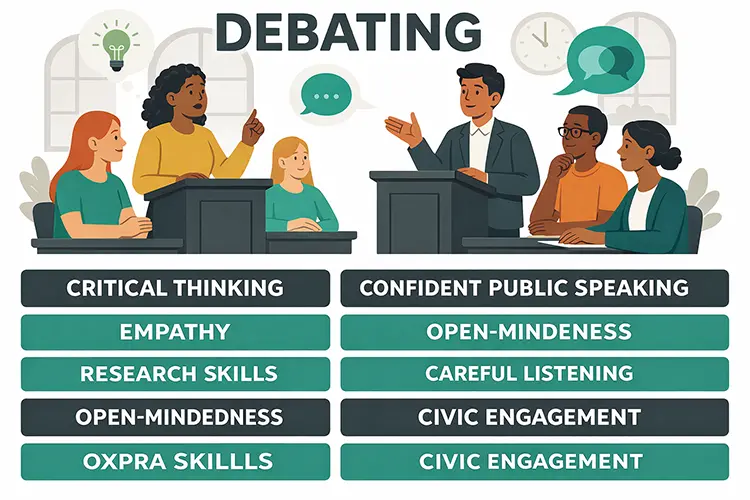
Benefits of Choosing Controversial Debate Topics
- Critical Thinking: Discussing a controversial topic makes you look at detailed information in a new way, so you will have more refined reasoning abilities.
- Empathy: Likely through the research process and exposure to the views of Opponents, you may learn to see and recognize views of others and be able to use this to dissolve divisions.
- Research Skills: Controversy is always accompanied by the need to reach credible evidence and to prove both sides of the argument, and the case sharpens your skills to find and evaluate information.
- Open-mindedness: Committing to listen to and hear those who have strong opinions on the other side, researching an insight leaves you with an open mind to who might want to change your opinions, as well as absorbing new ideas.
- Confident Public Speaking: The ability to persuasively and decisively present one's point of view on a challenging issue increases one's faith in one's own persistence.
- Careful Listening: A controversial topic will demand that you analyze the details of the argument of the other side, becoming much more adept at listening and responding.
- Teamwork: Collaboration and communication are enhanced in a group debate as people resolve to build an attack argument on a hard topic.
- Civic Engagement: Discussing controversial topics is an applied lesson in active citizenship, and this will help you know how to engage in decision-making and discussions in society.
General Controversial Debate Topics
In order to effectively have a serious conversation, you must consider all the controversial topics for debate. The ethical issues that arise with new technologies, general questions that society has lived with, and world issues are some of the areas that are meant to get the student thinking about how they ought to develop an argument. The given lists can serve as a beginning of the discussion concerning social, political, and environmental issues:
Social Issues
This type of debate is more socio-centric as the issues covered are those that relate to society and human relationships in general, and can mean reflecting on ethics, culture, and individual rights. The controversial debate topics in this category are perfect when learning about the way the communities can work and how we can solve complex human-centered issues.
Social Debate Topics
- Are social media companies at fault when it comes to transmitting inaccurate information?
- Should art and music that are the result of AI be created without the input of human beings?
- Does school need an encompassing mental health education in the curriculum?
- Is the emergence of the so-called cancel culture the enemy of free speech or a way to hold each other accountable?
- Do all public schools need security or police on campus?
- Do human genetic engineering and modification have any ethical implications?
- Is the personal data that businesses can use to create targeted advertising permissible?
- Is the gig economy helpful or harmful to the long-term financial survival of the employees?
- Is there a need to have a basic income to deal with job replacement due to automation?
- Are there enough social perspectives that are reflected in the mainstream media?
Political Issues
Governance, policy, law, and international affairs are the subjects of political debates. These themes invite a thorough exploration of the frameworks of power and the real-life outcomes associated with political judgments regarding citizens and the world community.
Political Debate Topics
- Is voting a formal civic obligation for all qualified citizens?
- Should the Electoral College be eliminated and replaced by a national popular vote?
- Is it right to have a wealth syndrome against the rich to fight inequality in the economy?
- Does a two-party political system help a democratic government or restrict it?
- Would it be good to introduce online voting to maximize the number of voters, even though it may not be safe?
- Does the existing campaign system of finance require major revision?
- Is there a need to have a federal regulation on the age limit to use social media?
- Is it necessary that all young adults participate in a national public service program?
- Is it moral to employ sophisticated surveillance technology on nationals by governments in the name of national security?
- Is it time to make universal healthcare available?
Environmental Issues
The environmental emphasis is on the correlation of people and nature. These controversial topics for debate have contained science, economics, and policy, and have put into question what our responsibility to the planet is and whether our actions are sustainable enough.
Environmental Debate Topics
- Should governments put more money into nuclear energy as a form of clean, sustainable power source?
- Are electric vehicles a real solution to environmental issues, or do they bring about new ones?
- Should governments require companies to reduce their carbon emissions to a certain level?
- Is it a moral duty to be a vegetarian in order to combat climate change?
- Is it time that the usage of single-use plastics should be banned globally?
- Is supporting the developing world by giving them money towards climate contributions the role of the developed world countries?
- Can a carbon tax help cut down the emissions of greenhouse gases?
- Is economic growth above saving the environment?
- Is aquaculture worse than other processes of food production?
- Is there a need to restrict agricultural land uses to save biodiversity and wildlife habitats?
Controversial Debate Topics for High School Students
Studying the complex topics and timely issues in a known debate format is a good choice or decision for high school students to enhance their critical thinking and communication skills. The controversial debate topics for high school are chosen to be related to the topics of their life and the surrounding world, and they are invited to explore, develop their opinion on it, and express it clearly and precisely.
School-Related Issues
The concerned areas in these topics surround the policies, practices, and challenges in the educational system. They base debate in this category on enabling students to talk about the environment they are taught in, as well as support ways they think they should be changed, so as to experience a better learning period.
School Issue Debate Topics
- Are four-day school weeks in high schools a good idea?
- When using AI tools as a homework and essay helper, is it considered cheating or a learning tool of the new era?
- Can cell phones be prohibited in schools during school time?
- Do standardized tests demonstrate accurate measures of the intelligence component in students?
- Are mental health days to be excused as such?
- Should schools implement such surveillance technology as facial recognition?
- Would you make financial literacy a graduation requirement for students?
- Are AP and dual-enrollment courses too stressful?
- Is it the role of the schools to feed all the students with healthy, free meals?
- Will the scholastic or academic curriculum be transformed to train in more vocational and life skills?
Youth Culture
The controversial topics to debate about the youth culture are those issues concerning the trends, problems, and social interactions that affect the lives of the young. Such conversations help engage the students in critical reflection of their lives, media, and interaction.
Youth Culture Debate Topics
- Are the effects of social media on the mental health of teenagers positive or negative?
- Can the influencers be held accountable by law to push dangerous products or content?
- Video games present a better type of entertainment and community building, or is it a waste when it comes to killing time?
- Do children have to have a cut-off age to use social media sites?
- Is self-esteem among young people affected adversely by the online search for an ideal digital identity?
- Is fast fashion and internet shopping leading to an over-consumption culture?
- Do we need to regulate online gambling and loot boxes in video games more?
- Is the conventional gap year effective in the form of application to students prior to college?
- Are online communities and friendships as advantageous as real-life ones?
- Are youths supposed to be more political and join civic protests?
Global Issues
International debatable topics encourage the students to think beyond their immediate societies and consider global problems. The controversial topics to debate about all these issues stimulate them to think of themselves as being global citizens and be critical about international relations, human rights, and global economics.
Global Issues Debate Topics
- Are developed countries supposed to take up more refugees?
- Are the more developed countries obliged to give developing nations finances in terms of morality?
- Is there any need to have an international entity that has the power to call on nations to subject themselves to environmental laws?
- Is it worth spending money to explore space when there are issues on Earth?
- Are all countries entitled to develop and utilize nuclear energy?
- Is the rest of the world doing enough to fight against the climate crisis?
- Will there be international law about the use of autonomous weapons?
- Is the free trade system in the globe fair to everyone?
- Does the World Health Organization (WHO) need greater authority to tackle pandemics around the globe?
- Does the present international copyright system serve the interests of all creators?
Controversial Debate Topics for College Students
Campuses provide a colorful atmosphere where controversial debate topics for college can be debated. Such dialogues form an important aspect of intellectual growth and enable students to perfect their critical thinking and communication skills. They tend to raise questions that do not have simple solutions, which force the participants to think along various lines.
Academic Freedom
This type of argument addresses the issue of conflict between the role of an institution to promote free inquiry and its obligation to provide an inclusive and secure atmosphere. Such issues usually relate to free speech restrictions on a college campus, why attempts at faculty in public discourse are inappropriate, and what the contents of the curriculum contain.
- Is there censorship of what a professor may say in the classroom?
- Does cancel culture pose a threat to academic freedom on college campuses?
- Is it right that universities should disinvite controversial speakers?
- Does it fall under the duty of a university to keep offensive speech away from the students?
- Is a mandatory diversity class in colleges necessary?
- Is tenure set to end so as to increase accountability among faculty?
- Does academic freedom cover student-instigated demonstrations that disrupt conferences at universities?
- Do trigger warnings in classrooms amount to an accommodation or censorship?
- Is it ethical or politically correct to divest in companies or countries because of moral or political reasons?
- Does this source of funding for a university have an impact on its academic liberality?
Technology and Ethics
These arguments enter into the ethical and social aspects of fast technological progress. They discuss the issues of privacy, artificial intelligence, and social influence of digital platforms, and necessitate that the participants measure the innovation against possible damage.
- Will the government control the advance of artificial intelligence?
- Do social networking sites increase misinformation?
- Is it adequate that companies are permitted to sell and gather information about their consumers without obtaining express approval?
- Is the military application of AI and autonomous weapons systems ethical?
- Is there a right to be forgotten on the Internet?
- Is the application of facial recognition dangerous to privacy?
- Is it necessary to improve human traits through the use of gene editing technology such as CRISPR?
- Is planned obsolescence of a product a moral practice among companies?
- What do you think, should students take advantage of AI tools such as ChatGPT in their academic work?
- What is the privacy of the digital footprint of an individual?
Social Justice
The genre is concerned with the equitable offer of resources, advantages, and rights of the society. The controversial debate topics for college surrounding the subject of social justice are expected, as students are provided with opportunities to query inequitable structures in society and what can be done to accommodate a fairer society.
- Is diversity through affirmative action in college admissions a needed tool or reverse discrimination?
- Is it right to get reparations for historical injustice such as slavery?
- Should Universal Basic Income be used as the way out of poverty and income inequality?
- Do we need to have the freedom of speech in hate speech?
- Is there a bias in the criminal justice system against particular communities?
- Is the concept of wokeness in media and advertising actively facilitating social change, or is it a marketing ploy?
- Is it time to have a ceiling salary to deal with the widening gap between the rich and the poor?
- Does it fall on the government to ensure that everyone has low-cost housing in the country?
- Is gender-affirming care inadvisable when such care is applied to minors?
- Is a colorblind society an ideal that is real or a means to forego racial inequality?
Controversial Debate Topics for Adults
In the current sophisticated world, adults often find themselves in arguments that invoke the fundamental institutions in society, be it the workplace or government policy. These controversial debate topics for adults also play a crucial part in defining the future, since they include the struggle with the existing norms and the option to reflect on some new thought patterns.
Workplace Issues
This style is concerned with changing the working environment and the connection between the employers and the employees. Some of the arguments about this topic are related to the equality question, the evolution of new technologies, and the ratio of professional integrity and the well-being of people.
- Is hybrid work an option that should be made available to every workable position?
- Does the four-day workweek as a system of raising productivity and the level of fulfillment have a future?
- Are employers to be judged legally liable for employee burnout?
- Is artificial intelligence and automation a net positive to the workforce or a risk to jobs?
- Will a national maximum wage combat inequality of income?
- Is the use of employee surveillance technology an acceptable means of gauging productivity?
- Is it necessary that companies reveal the pay spectrum in each employment opportunity?
- Is the so-called gig economy a way of empowering the workers or a means of exploitation?
- Is there to be a statutory restriction on the number of hours an employee may be required to work per week?
- Is a college degree the best bet for career success?
Health and Wellness
These are the matters regarding the tricky ethical, price, and societal aspects of health care. Providing care, the rights and duties of the state, and the state of personal responsibility versus the state of people is usually an argumentative issue.
- Is universal health care something that should be accessible to everybody?
- Do prescription drugs physically advertised by the pharmaceutical companies promote ethical misconduct?
- Would it be appropriate to have a mandatory vaccination policy for all vaccine-preventable diseases?
- Do expensive prescription drugs show a breakdown in market capitalism, or are they the price of innovation?
- Is assisted dying legal for terminally ill patients?
- Are intuitive eating and anti-diet culture beneficial, or are they causing harm to people?
- Are new genetic modification technologies, like CRISPR, to be regulated by the state?
- Do community health-related projects like that of the soda tax or the smoking ban represent an intrusion of personal liberty?
- Is mental health care as critical as physical health care, and should it be insured to the same degree?
- Are medical and cosmetic products' animal testing morally right?
Economic Policies
This form of argument challenges the ways to handle the economy used by the government and institutions. There are controversial debate topics for adults between various schools of thought, whether this is on a market-based solution or more state-run policies, and how these policies affect our everyday lives.
- Can a universal basic income (UBI) help to fight poverty and economic insecurity?
- Is raising the national minimum wage to a living wage a good policy?
- Do trade tariffs and protectionist policies end up as either beneficial or harmful to the economy of a country?
- Are wealth taxes needed to pay for social programs and inequality?
- Is the national debt of a government a matter of serious concern to the new generations?
- Does capitalism have an irreconcilable conflict with environmental sustainability?
- Does the stability of prices or the full employment of citizens need to be the main objective of the central bank?
- Does deregulation in the financial sector make economic growth, or is it a cause of instability?
- Should the government absolve all student loans?
- Is it really the natural act of having extreme wealth in the hands of very few folks in a free market, or is it a result of systemic failure?
Geo-Specific Controversial Debate Topics
Most controversial debate topics of contention are, in a way, ingrained in the history, politics, and even cultural values of a country. Such geo-specific debates tend to mirror discussions and issues going on nationally that are of great importance on a regional level.
United States
Domestic arguments usually center on ideas of personal liberty, the position of the federal government against the rights of the states, and an extensive array of social problems. Such discourses are often influenced by the constitution and decades of protests and social movements.
- Do you think that it would be more democratic to eliminate the Electoral College and use the national popular vote?
- Does the existing gun control pose a risk to the safety of the people, or is it a constitutional requirement?
- Is it correct to give justices in the Supreme Court a lifetime appointment?
- Is the increase in national debt a viable economic model?
- Would it be permissible for states to enact their own immigration policies?
- Do we want the federal student loan forgiveness programs as a good economic policy or a moral hazard?
- Is the learning of Critical Race theory in schools healthy education or segregation?
- Does the government have a role to play in providing affordable care to its people?
- Is there a need to have a national policy that should guard or curtail abortion?
- Is a two-party political system enough to represent the plurality of opinions?
India
In India, the debatable issues relate to peculiar cultural diversities, socio-economic issues, and the thin line between tradition and modernisation. Issues of secularism, federalism, and how a vast and varied people can be developed economically are often matters of concern.
- Does the Uniform Civil Code have a role to play in the integration of the country, or does it violate religious freedom?
- Is the government supposed to do more in terms of controlling social media and the contents of the internet?
- Are there benefits to the economic growth of the country in privatizing the public sector enterprises?
- Is there to be a more centralized way of governance, or should states be left to their own devices?
- Does India still have to carry out reservations and affirmative action due to historical disparities in its modern day?
- Does the freedom of expression get cut short due to the issue of national security or law and order?
- Are there any laws that should be tightened on the environment at the expense of the fast growth of industries?
- Does the old method of the joint family system work better as a support system than the nuclear family?
- Is it right for the government to subsidize certain religious pilgrimages?
- When considering the other infrastructure needs, is the high-speed rail a good investment of the public's dollars?
United Kingdom
In the United Kingdom, its parliamentary system, history as a world power, and changing relations with Europe have been seen to influence some controversial debate topics. The issue of national identity, the role of public services, and the impacts of political moves such as Brexit on people, or the concerns of the future, are often flavors of debate.
- Has Brexit proven to be a success or a failure of the country in the long term, morally, economically, and politically?
- Would you like to have less or eliminate the role of monarchy in contemporary society?
- Do existing immigration policies ensure an optimum balance between economic demands and social assimilation?
- Is it necessary to privatize the National Health Service (NHS) in order to enhance efficiency and cut waiting times?
- Will giving more power to the Scots, Wales, and Northern Ireland pose a danger to the unity of the nation?
- Is it harder to keep the voting age at 16?
- Is the first-past-the-post kind of electoral system fair, or should it be substituted with a bit of proportionate representation?
- Are climate change combating measures bringing an unfair economic burden on ordinary citizens?
- Is the foreign policy of the government to be more international alliance-oriented or a go-it-along strategy?
- Do the current statutes on the freedom of speech and hate speech require revocation?
How to Choose a Controversial Debate Topic
The idea of a good debate starts with selecting an interesting topic, and at the same time, the how to choose a controversial debate topic guide is a good exercise in critical thinking. Students are able to choose a topic that allows them to think deeply and, at the same time, be easily understood by other students.
Consider Your Audience
Students will have to consider what their peers and the teaching staff will be interested in reading when selecting a topic. The best topic has to relate to what they are going through or what is happening, and therefore, the argument in that topic feels closer to their hearts. This takes into account and creates a greater sense of authentic interest and engagement on the part of all of the involved people.
Ensure Researchability
It is essential that students select a topic that would be backed by evidence. They ought to seek topics on which they can get an abundance of information from journals in academia, news, and other reputable sources of data. This method removes debate from the realm of personal opinion and into a space where it is possible to argue on the basis of facts, which is a necessary part of a good debate.
Balance Complexity and Accessibility
The topic needs to be complex enough to be interesting, but not technical to the point of difficulty for a general audience. The ideal subjects are suited with several layers of subtleties and meanings, although everyone in the room can grasp what they are all about. It enables an intellectual dialogue of ideas, and at the same time avoids being trapped in terminologies.
Tips for Debating Controversial Topics
Arguing out an issue that is controversial needs tact and planning. These tips for debating controversial topics should allow making the discussion both fruitful and friendly, and more based on the substance than on the emotions.
Stay Respectful
- A tone of respect must be used in the discussion.
- Your efforts should not be on attacking the individual, but the opponent's argument.
- Actively listen to what the opposing team has to say and use courteous language even though you disagree entirely.
- Wait for the opponent to finish their points and respond accordingly.
- This method can create a more productive atmosphere, and it will allow the debate to take place without turning into personal insults.
Use Credible Evidence
- Facts are always beneficial to a strong argument.
- Arguments used by the debaters need to be supported with valid facts, which can be found in academic research, government statistics, or credible news institutions.
- A reference to particular statistics and the opinions of the scientist will make your arguments more objective.
- It will demonstrate that your standpoint is not grounded on a mere opinion but on diligent study.
Anticipate Counterarguments
- Planning must be one of the ingredients of a great debate.
- Make sure that, before a discussion, you have time to study the position of the opposite side and know its strongest side of its arguments.
- Knowing their answerable points, you will be able to develop a response before the discussion.
- It will make your argument more effective and indicate a better grasp of the problem.
Common Mistakes to Avoid
When you are having a debate on any controversial topic, knowing certain tactics to make it impressive and avoiding debate topic mistakes is important. Such mistakes that you must ignore are listed below:
- Striking at the speaker of an argument rather than striking at the argument itself.
- Not using valid evidence and logical arguments by appealing to the audience emotionally or by using stories.
- Failure to listen to the points of the opponent will make one generate poor responses and a narrow argument.
- Using poor logic, e.g., by setting up a straw man to distort the position of the opponent.
- Generalizations are based on improper evidence.
- Without any research on the topic, you can find yourself without an argument against potent objections.
- Losing the main subject of the argumentation.
- Applying an over-the-top aggressive, condescending, or disrespectful tone.
Resources for Controversial Debate Topics
When it comes to the controversial debate topics resources you can consider, not just for topic recommendations, but also for debate ideas and key points. However, the best would be to discuss it with your professors and peer group and gather information about it. Reading the newspaper and being updated about your surroundings will also be helpful in picking the most controversial topic for debate.
Conclusion
As per our discussion, a matter of controversy is one in which there is much disagreement and no simple answers are possible. Selecting one controversial debate topics successfully has to do with considering your own audience, making sure that it can be researched, and being able to find a balance between complexity and accessibility. The main clues that apply to the course of action during the debate are to be respectful, to employ credible evidence, and to expect any counterargument as a way to enhance your stance. It is also essential not to fall into a typical trap, such as personification or emotional plea, and make an effective exchange.