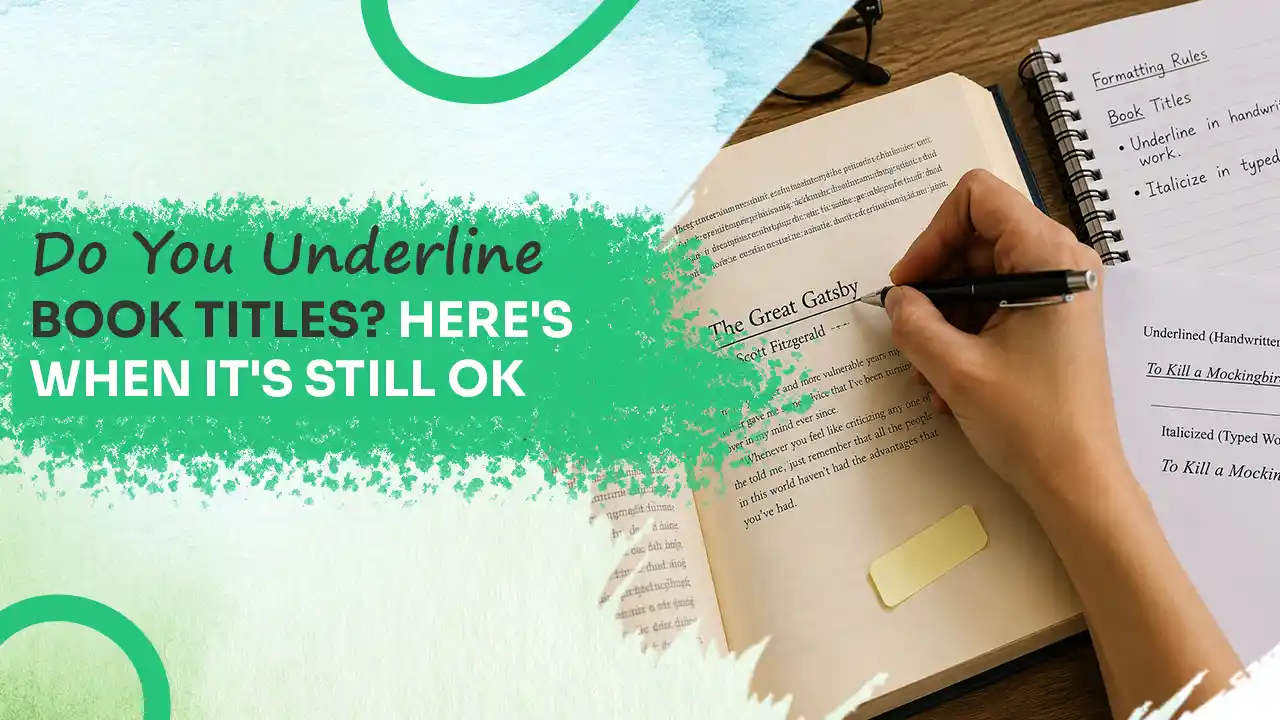
The quick answer is no to underlining the book title while typing, but you can do italics. But there is a catch in it, and that is underlining didn't disappear from the rulebook; it's just been demoted. Few people will tell you why or when it makes its reappearance.
Typically, most people know only one version of the rules during their time in middle school and an entirely different one in college, with no explanation of the change whatsoever. And honestly, this can create lots of confusion in the mind. Hence, to make all the things simplify, here we break down the process and offer some examples along with the verbatim language from the style guides. On top of that, you will also get helpful tricks that are never mentioned anywhere else.
Quick Answer: Italicize When Typing, Underline Only by Hand
Are book titles italicized no matter what you type them in? Indeed. This is what you should do according to MLA, APA, and Chicago style, which account for the overwhelming majority of essays you will write in school or college. Underlining is left for emergencies when italics cannot be applied, say, during an exam written by hand. There is one deafening exception you should keep in mind. AP style, the journalistic format, avoids both italics and underlining and puts book titles into quotation marks.
One rule to remember in case of emergency. If you can create an italic underline. If not, underline is next in line.
Why Underlining Used to Be the Standard
The Typewriter Era
Imagine a typewriter and a writer beating at it in 1965. Each letter the machine made was upright, stiff and equal. After each key, on every page, one uniform font.
That came as a serious issue. There was still a need for editors and publishers to mark some words as a variation of others, particularly titles. Underlining was done by hand by the writers and it served as a message to the typesetter. This is to say, “When it is ready to be printed, make this appear in italics.” There was no doubt about it. That's the way publishing had gone for most of a century.
The Shift to Word Processors
Then there were word processors, and things changed virtually overnight. In one day, anyone with a keyboard could create real italics with a single click. The workaround underlining was no longer needed, and one by one, style guides changed their rules to follow. The use of italics was encouraged in typed writing, and underlining was not used as much.
Where Underlining Still Survives
This never went away, however. Underlining remained alive in hand-writing, as could not yet be achieved using pens and pencils in italics. It also had an unusual second life as well. With the advent of the Internet, underlined text was a shorthand to one thing: a clickable link. That is why it's a little bit easier to feel a bit off in a formal paper now. A reader reads it and naturally assumes it must mean something; that there is a destination.
Curious how this same shift played out for other kinds of titles? Our guide on why italics replaced underlining traces that history across several different media, not just books.
The MLA Plain-Text Trick Most Guides Skip
Here's a detail most articles on this topic skip entirely, and it's a genuinely useful one. MLA's own style guidance doesn't just cover handwriting when it comes to underlining. It applies to digital formats where the italics and the underline won't work for some reason – ancient chat clients, some text-only formats, etc. When it happens, MLA suggests putting an underscore on each side of the title, which makes The Great Gatsby be written this way: The Great Gatsby. This is just a trick, and one can clearly see that the main rule wasn't about underlining or italicizing the titles.
And here is the burning question everybody is dying to know the answer to. Do you underline or italicize book titles, and does it matter whether it's your assignment or not? It certainly does matter.
Do You Underline or Italicize Book Titles? (Style Guide Rules)
Here is the burning question everybody is dying to know the answer to. Do you italicize book titles, and does it matter whether it's your assignment or not? It certainly does matter
What MLA, APA, and Chicago Say
MLA, ninth edition, wants italics for any full book title in typed work. This is the format most English classes lean on, so if you're writing a literary analysis, italics are almost certainly the expectation.
APA, seventh edition, follows the same logic. Book titles get italicized both in your paragraphs and in your reference list. You'll run into this format most in psychology, education, and social science courses.
Chicago style agrees too. Standalone works, books included, get italics. This one shows up often in history classes and traditional publishing.
At a glance:
- MLA (9th edition): Italics for full book titles in typed work — the go-to for English classes and literary analysis.
- APA (7th edition): Italics in both body paragraphs and the reference list — common in psychology, education, and social science courses.
- Chicago style: Italics for standalone works, including books — frequently used in history classes and traditional publishing.
Why AP Style Breaks the Pattern
Then there's AP style, and this is where things genuinely flip. AP style, used across newsrooms nationwide, doesn't use italics at all for composition titles. There is clear no for books, movies, and songs. Instead, nearly everything gets wrapped in quotation marks. AP's own style guidance states this outright, no italics, quotation marks around almost every title you can think of. That single rule catches a lot of students off guard, because it seems to contradict everything they've been taught elsewhere.
So three major style guides say italicize. One says neither, use quotes. Underlining doesn't appear as an approved option in any of them for typed work. It only earns its place when italics simply can't be produced, which brings us to the part most articles skip entirely.
When Is It Okay to Underline a Book Title?
This is the part almost every competing guide skips, and, no matter what it's about, students really want to know. Is it okay if you write books in cursive and do it the best way to underline the title - will a teacher deduct a point for it? No, in nearly all.
Underlining is okay if:
- You are taking a handwritten essay or an in-class test, and they require you to write it all in italics, but you can't use a pen to write some in italics.
- You're completing a plain-text form (paper or electronic) that removes options for formatting.
- Your instructor specifically requests it, even on typed assignments.
Handwritten Essays and In-Class Exams
Handwritten essays and in-class exams top the list. You can't physically produce italics with a pen. Underlining is the accepted, expected substitute here, full stop. If you're mid-exam and you underline a book title instead of somehow trying to slant your handwriting, you're doing it exactly right.
Plain-Text Forms and Instructor Requests
Plain text forms come next. Sometimes you're stuck filling out a form, paper or digital, that strips away every formatting option. Underlining still gets the point across clearly, even without real italic formatting available.
And then there's the instructor exception. Every so often, a teacher will ask for underlining specifically, even on typed assignments, maybe because that's how they learned it decades ago. When that happens, follow their instructions. Always. A direct request from whoever grades your paper outranks any general rule in this article.
Converting a Handwritten Draft to a Typed Final Copy
One more thing worth flagging, since it trips people up constantly. If you have a rough draft written by hand and type the final version, reread the draft and make the appropriate changes for the titles from underlined to italicized prior to submitting the work. That's a little step that can easily be avoided and it does occur more often than you might think.
A Real-World Example: Same Book, Two Formats
Let's look at a scenario to walk through as it encompasses nearly all edge cases. Say you're in-class a timed in class essay exam on The Odyssey. You underline the title three separate times throughout your response, because that's the only option a pen gives you. Later that week, your teacher assigns a take home essay on the same book, typed and submitted online. In that second essay, every mention of The Odyssey needs italics instead. Same book, same student, same class, two completely different formatting choices, and both of them are correct for their specific situation. That's really the entire rule in miniature. The format changes based on how you're physically producing the text, not based on the book itself.
Do You Underline or Quote Book Titles?
Quick gut check. Do you underline or quote book titles, or can you technically do both for extra emphasis? Neither, and definitely not both together.
Underlining and italics exist to do one job. They flag a complete, standalone piece of work, something published entirely on its own. A novel fits that description perfectly. The use of quotation marks is meant to serve an entirely different purpose. This is a means of identifying something small embedded within something big, such as a chapter from a book, a short story contained in an anthology, or a poem within a larger body of poetry.
Because these two uses are quite distinct, it is important that the name of a complete book not be enclosed in quotation marks in any case, according to the MLA, APA, and Chicago format. The only exception to this rule is the use of quotation marks for the title, without underlining or italicizing the title. Stylizing a title by making it in italics and then adding quotation marks is not a way of emphasizing the title but simply wrong.
Note: When referring to a novel, you use italics and no quotation marks. However, if you cite a particular chapter of this book for your analysis, then the chapter title is quoted and the name of the book, which is italicized, is also included in the sentence. Similarly, if you're wondering, "Do you italicize song titles," the formatting rules are different from novels and depend on the type of work being referenced.
What About Book Series? (Harry Potter, Star Wars & More)
Series names throw a small curveball, and this is genuinely one of the most common points of confusion out there.
When you're referring to an entire series in general terms, that name usually gets no formatting at all. You'd write the Harry Potter series with nothing italicized and nothing underlined, because you're describing a broad collection, not one specific published book.
An individual title inside that series is a different situation completely. Each one still follows the standard rule for standalone works. So a specific book like Harry Potter and the Prisoner of Azkaban gets italicized, exactly the way any other book title would.
Star Wars follows that same pattern. Talking about the franchise as a whole? No special formatting needed. Referencing one specific novel tied to that universe? Treat it like any standalone book, italics when typed, underlining when handwritten.
Once that distinction clicks, it becomes remarkably easy to apply across almost any franchise you're writing about, whether it's a decades old classic or something released last year.
Quick rule of thumb:
- Series name, referenced generally (the Harry Potter series, the Star Wars franchise) → no formatting.
- One specific book within that series (Harry Potter and the Prisoner of Azkaban) → italics, same as any standalone title.
What About Movies, TV Shows, and Other Media?
The same core logic stretches well past books. Are movie titles italicized using this same rule? Yes, and under MLA, APA, and Chicago, full movies and entire television series both get italicized, following the exact standalone work reasoning used for books.
A Star Wars film title follows the identical pattern you'd use for a Star Wars novel. Both count as complete, independent works, so both get italicized in typed writing. Curious about trickier situations, like individual TV episodes or streaming exclusive titles? Our full guide to italicizing movie and TV titles covers those edge cases in far more depth.
One quick distinction worth mentioning here, since it catches people off guard. A whole TV show is generally italicized and treated equally as a film or print book. Though, a particular episode will only use double quotation marks since such an episode is more comparable to a chapter than a complete independent book. If you were quoting a full series of programmes, you would underline the title of the programme, but if you were quoting a particular programme within the series you would quote it in double quotation marks.
In short:
- Full movie or entire TV series → italics (or underline by hand).
- A single TV episode → quotation marks, since it functions like a chapter rather than a standalone work.
What About Plays?
Plays land in the same category too, and the logic barely shifts. A play counts as a complete, standalone published work, much like a feature-length film, so it earns the same italics treatment whenever it's typed.
If your assignment requires using a play as a source of information, there are a few additional matters, beyond the play's title, that will be covered: What the act and scene numbers are and how they are used within the citation. We're here to take you through how one can cite a play in MLA format.
Quick Reference Table: Underlining vs. Italics vs. Quotation Marks
Sometimes a table just works better than another paragraph. Here's one worth bookmarking.
|
Situation
|
What to use
|
Example
|
|
Typing on a computer, phone, or tablet
|
Italics
|
The Great Gatsby
|
|
Handwritten essay or exam
|
Underline is an acceptable substitute for italics
|
The Great Gatsby, underlined
|
|
Writing in AP style
|
Quotation marks, no underlining or italics
|
"The Great Gatsby"
|
|
A shorter work inside a book, like a chapter or poem
|
Quotation marks
|
"Chapter One"
|
|
A book series name, referenced generally
|
No underline, italics, or quotes
|
the Harry Potter series
|
|
One individual book within a series
|
Italics
|
Harry Potter and the Goblet of Fire
|
|
Plain text box with no formatting tools (MLA)
|
Underscore on either side of the title
|
The Great Gatsby
|
Final Takeaway
Formatting a book title feels like a tiny detail, right up until it costs you a point on a paper you worked hard on. Do you underline book titles or reach for italics? Now you know exactly which one to grab, and exactly when the other one is still fair game. Bookmark this guide, keep it open the next time you're finishing an essay at midnight, and you'll never have to second guess a title again.