If you have ever read a line in a play or a pop song and caught yourself grinning at a "hidden" second meaning, you have already met the double entendre. One of literature's oldest delights used to put two ideas in one sentence, with a pleasant idea at the surface, and an underhand one just below.
Continue reading below to get knowledge about double entendre definition and examples. Along with this you will also get practice worksheets to improve your skills so that you can write your own with much confidence and creativity. As a student, teacher or simply curious reader you will come with more than 50 examples and with a good understanding of how this device works by the end.
What Is a Double Entendre? Definition and Meaning
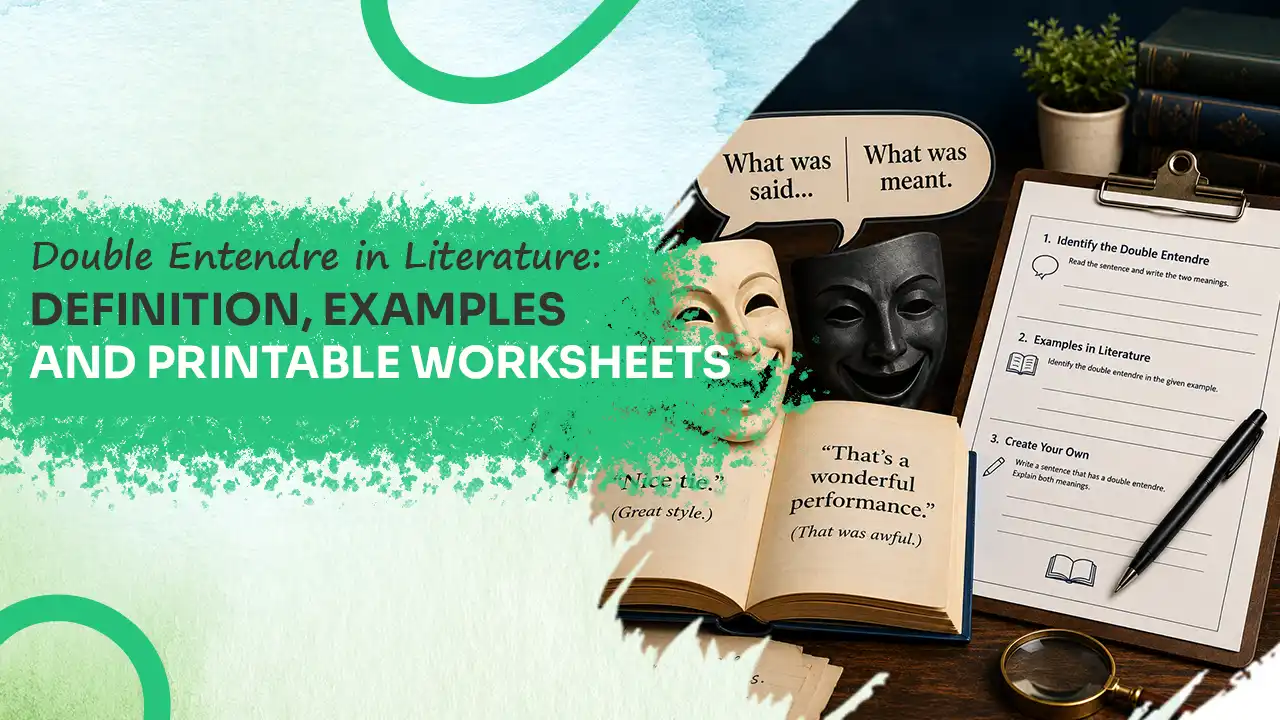
A double entendre is a genre of word that the listener may interpret on at least two levels; either is apparently literal, or entirely harmless, or both; the other is apparently implied, suggestive or even cheeky. It is hoped the listener or reader would be allowed to see the first meaning the first time, and the second meaning either the second time or known only to those "in the know. This is one of the best aspects of the device—the delayed recognition moves people right along with it, but it doesn't threaten those who are paying attention.
The French term double entendre means "double understanding" or "double hearing. It is a linguistic fossil - it is not used so much in modern French, but has been fully incorporated into English, particularly in theatre and satire, since the 17th Century.
Some understanding of the difference between a double entendre and its close relatives is helpful:
|
Device
|
Key Feature
|
Example
|
|
Double Entendre
|
Two meanings – one literal, one suggestive – surface meaning is innocent
|
Nice night for a stroll, (said while sneaking to some place)
|
|
Pun
|
Two meanings, both equally valid and often comic, based on sound-alike words
|
I'm currently reading a book about anti-gravity, it is really impossible to put down.
|
|
Innuendo
|
Suggestive implication without a genuine, grammatically complete second literal meaning
|
A raised eyebrow and "you know what I mean"
|
Writers use this device as a form of witty and sophisticated language, it gives the audience a chance to elicit meanings from the reader, to infer romance, danger, humour and so forth, without necessarily resorting to specific vocabulary in censored eras or for a wide-ranging audience. It also introduces prose in layers and lines have several purposes.
Double Entendre Examples in Literature
This is a technique the author has used for hundreds of years, before the term 'innuendo' was coined to describe a comedy routine of its own. Double meaning has shaped the dialogue for writers ranging from Shakespeare to Jane Austen to Oscar Wilde, and has been used to elucidate meaning, to censure social manners, or merely to get one's humor past a contemporary censor. First, we'll examine the playwright who first made the device popular in English, and then, we'll turn to more contemporary literary use.
Double Entendre Examples in Shakespeare
Shakespeare appears to be the single outstanding source of double entendre examples in literature that are still studied in the English classroom today. His comedy and his tragedy are full of word play that makes perfect sense on the page, or on the stage sheet, but would have had a much-strengthened meaning to Elizabethan audiences who understood the slang. Below are some of the most famous examples and majority of them are examples of double entendre in romeo and juliet.
- "Do you bite your thumb at us, sir?" (Romeo and Juliet, Act 1): Possibly a direct rude insult between servants of the feuds, just at the surface. Biting thumb had other crude associations in Elizabethan street slang, further fueling the first fight.
- "My naked weapon is out" (Sampson, Romeo and Juliet, Act 1): “Naked weapon” is a statement about his physique as well as about his intentions to fight; the play’s pervasive mixing of fight and desire begins here.
- Much Ado About Nothing - the title itself: In Elizabethan-era slang the term "nothing" referred to the female genitalia, and the title quips at the romantic and sexual tangles the play would portray without a word being used.
- "Country matters" (Hamlet to Ophelia, Hamlet, Act 3): Hamlet requests Ophelia's permission to lie in her lap and when she withdraws this permission he says that his intention was nothing more than "country matters" which would have been immediately recognized by Elizabethan readers as a puns on the first syllable of country.
- "O, that she were an open-arse, and thou a poperin pear!" (Mercutio, Romeo and Juliet, Act 2): Mercutio's fruit-based joke about Romeo hides an anatomical pun behind fairly ordinary orchard vocabulary.
- "I see that the fool should be the tutor to the wise" (Twelfth Night): Feste's jests are literary equivalents of the double meaning, a more obscurable and quiet way of commenting on the social function of the individual.
Here Shakespeare crucially weaves both humor and seriousness, tickling laughter and provoking thought without end from his audience over the ages.
Double Entendre Examples in Modern Literature & Poetry
Elizabethan slang was not necessary for every writer to make a double meaning land. Later writers made it quieter, more knowing about the world than lewd than it still features prominently in modern novels and poetry.
- Oscar Wilde, The Importance of Being Earnest: All the play's themes and ideas hinge on the double sense in "Earnest" as a name and as a character quality, allowing Wilde to lampoon sincerity in the Victorian era in a decorous manner.
- Jane Austen, Pride and Prejudice: But when Mr Bennet says he has "a high respect for [Mr Collins's] nerves", he means it as a tame reminder of how theatrical his wife is, rather than something risqué.
- Dorothy Parker's poetry: Parker's crisp, pointed rhymes often resort to regular, even down-to-earth language ("men seldom make passes / at girls who wear glasses") which borrows a second cynical connotation as to vanity and courtship.
- Jonathan Swift, "A Modest Proposal": Not a double entendre in the usual sense, but Swift's literal proposal has a second meaning throughout; he illustrates just how much layers of meaning, one way and another, are possible within an essay.
Double entendres persist today in enriching modern narratives, appearing with a sophistication, humor and critique that offers multiple levels of engagement to the reader.
50+ Double Entendre Examples by Category
Double entendres can be found in daily life, novels, film, songs and commercials. Some are funny, some stimulate the reader to think, and some introduce subtle character interactions. Each of the following examples is broken down by category, making for easy, straightforward comparison.
Clean Double Entendre Examples (Classroom-Safe)
The following clean double entendre examples Double entendres can be found in daily life, novels, film, songs and commercials. Some are funny, some stimulate the reader to think, and some introduce subtle character interactions. Each of the following examples is broken down by category, making for easy, straightforward comparison.
|
Example
|
Surface Meaning
|
Implied Meaning
|
|
She's starting on a right note.
|
She's right on the right track.
|
She is making her way to success.
|
|
Finally he broke the ice.
|
Physical division of ice was made.
|
He began to converse in a friendly manner.
|
|
The teacher gave us a lot to digest.
|
Digest food.
|
Think deeply about information.
|
|
This project holds several layers.
|
Multiple physical layers.
|
Hidden complexity.
|
|
She has great influence in the company.
|
Physical weight.
|
She is influential and has authority.
|
|
The artist drew a crowd.
|
People gathered.
|
His artwork attracted attention.
|
|
He found the key to success.
|
A physical key.
|
The secret to achieving goals.
|
|
That idea really took off.
|
An object flew away.
|
The idea became popular.
|
|
We need to build bridges.
|
Construct bridges.
|
Improve relationships.
|
|
She has deep roots here.
|
Plant roots.
|
Strong personal connections.
|
|
His words carried weight.
|
Heavy objects.
|
His opinion mattered.
|
|
The debate opened many doors.
|
Physical doors.
|
New opportunities.
|
|
They sowed their seed of curiosity.
|
Planting seeds.
|
Inspiring new ideas.
|
|
The conversation hit home.
|
Reached a house.
|
Had a strong emotional impact.
|
|
The light finally came on.
|
A lamp turned on.
|
Someone understood the idea.
|
These double entendres examples demonstrate that a double entendre isn't necessarily related to romance or humor. A lot of people use figures of speech that add lushness to speech.
Funny Double Entendre Examples
Comedy frequently depends on multiple layers of meaning as the audience can appreciate the secondary meaning a little later to the joke. The following funny double entendre examples are age-appropriate and show you how writers and comedians make jokes.
|
Example
|
Why It Is Funny
|
|
I am currently reading a book on anti-gravity . . . It cannot be put down.
|
“Put down” both the book and interest.
|
|
"The bakery has a lot on its plate."
|
Refers to literal plates and being busy.
|
|
"He's climbing the corporate ladder."
|
Combines a physical ladder with career advancement.
|
|
The magician caused his point to vanish.
|
A pointed object versus proving an argument.
|
|
"The actor stole the show."
|
Didn't literally steal anything but dominated the performance.
|
|
"The coach has a winning formula."
|
Recipe vs successful approach.
|
|
"That speech really landed."
|
Physically landing versus making an impact.
|
|
"The comedian always delivers."
|
Package delivery vs package delivery of jokes.
|
|
"She keeps raising the bar."
|
An actual "physical" barrier versus a raise in standards.
|
|
"The editor cut the story."
|
Cutting paper versus shortening text.
|
It's a technique often employed in television sitcoms like Arrested Development, in which viewers discover the second meaning just as they think of the first one. These are some double entendre jokes examples showing that the jokes are about the use of words and don't contain offensive content.
Double Entendre Examples in Rap & Hip-Hop
Rap artists are renowned for their wordplay, their multiple metaphors as well as their cultural references. Instead of simply giving a lyric, the following examples provide an explanatory example of the use of the literary technique of some popular artists. The double entendre examples in rap lyrics illustrate how the lyricist can have multiple meanings and stay in the rhythm without sacrificing the storytelling.
|
Artist
|
Literary Technique
|
|
Kendrick Lamar
|
They are able to use place names and personal identity as one discrete element comments on both geography and personal growth.
|
|
Jay-Z
|
Often uses business terminology in response to artistic accomplishment enabling the same terminology to be applied to both music and entrepreneurship.
|
|
Eminem
|
Uses every day language with mentions of his work to interpret it at multiple levels, and contradicts the meaning based on those words.
|
|
J. Cole
|
Utilizes learning imagery which represents learning and life experiences.
|
|
Drake
|
Combines elements of sports with themes of relationships for undergrowth.
|
|
Nas
|
History-memories can function as both historical information and an evaluation of the current society.
|
|
Lil Wayne
|
Creates complex metaphors with multiple meanings about one object.
|
|
Common
|
Uses peaceful imagery which discusses community and personal reflection.
|
|
Black Thought
|
Often uses system of political language in the context of artistic expression to enrich interpretation.
|
|
Lupe Fiasco
|
Establishes sophisticated meanings with words that have literal or metaphoric properties.
|
Why hip-hop is often taught in literature and linguistics classes can easily be found in these double entendre rap examples. The artists don't sound out the words; they invite listeners to discover two or more meanings.
Double Entendre Examples in Movies & TV
Double-entendres occur in movies and on television to make a memorable phrase. At times, the implied second definition only is evident to viewers after they have read the story or familiarized themselves with cultural detail.
|
Movie/TV Example
|
Two Meanings
|
|
The Terminator – "I'll be back."
|
A literal promise to return and a symbol of the unstoppable character.
|
|
James Bond films
|
Bond's clever one-liners usually convey action, but also add an indirect “take on” to the relationship or situation.
|
|
Disney animated films
|
Writers add in layers of jokes that kids hear them as jokes and adults get more out of them.
|
|
Shrek
|
There's often something humorous going on on several levels, for younger ones and for older ones.
|
|
The Simpsons
|
Wordplay frequently has a satirical message about society, but it is funny.
|
|
Friends
|
There can be unspoken (unexpressed) emotion in topics of everyday conversation.
|
|
The Office
|
Humor frequently arises from otherwise innocent comments during a day's work due to the different ways in which these comments are understood.
|
|
Back to the Future
|
Dialogue is often ambiguous and occurs throughout the narrative in several different contexts to be fully understood later on.
|
These double entendre examples in movies prove that the art of good movie dialogue, in the form of double entendres, is a still very effective tool.
Double Entendre Examples — Flirting & Social Contexts
Double entendres are also expressed frequently in the natural speech of people. Individuals sometimes employ them used in an oblique manner as a welcome, funny, or romantic overture, but not in an overt one at all. The following double entendre examples flirting are clean and suitable for all type of audience.
|
Example
|
Surface Meaning
|
Implied Meaning
|
|
"You always brighten my day."
|
Make the day more happy.
|
Expresses personal affection.
|
|
I would like to get to know you better!
|
Learn more information.
|
Shows romantic interest.
|
|
It's impossible to forget, you're hard to forget.
|
Difficult to remember?
|
Indicates lasting emotional impact.
|
|
"You certainly leave an impression."
|
Memorable personality.
|
A compliment that indicates attraction.
|
|
"You're one of a kind."
|
Unique qualities.
|
A love that is not the normal affection of friendship.
|
|
I hope we'll get together again.
|
Meet again physically.
|
Longing to get a relationship in the future.
|
|
All conversations are interesting because of you.
|
Enjoyable discussions.
|
Enjoy spending time together.
|
|
"You always keep me smiling."
|
Cause happiness.
|
Indicates emotional connection.
|
Double-entenders can serve as tools to communicate your feelings and emotions sensitively in social contexts, leaving the listener feel free to come up with the "other" interpretation.
Double Entendre Example Sentences (Quick Reference)
Below are double entendre examples sentences, suitable for students to look at before their exams or in writing.
|
Sentence
|
Both Meanings Explained
|
|
The door finally opened for her.
|
A real door; a new opportunity.
|
|
He's gaining traction with his ideas.
|
Literally catching; becoming popular.
|
|
She made new heights.
|
Personal success; body size.
|
|
The team found its rhythm.
|
Musical timing, good co-operation and team working.
|
|
The speech struck a chord.
|
Musical chord; emotional connection.
|
|
He was leading the team.
|
Physical carrying; leading performance.
|
|
The road ahead looks clear.
|
Safe road; hopeful future.
|
|
They weathered the storm.
|
Survived bad weather; overcame difficulties.
|
|
She turned over a new leaf.
|
Reconstituted plant pictures; altered behavior.
|
|
The book opened my eyes.
|
Eyes literally open; gained understanding.
|
|
He has a bright outlook.
|
Optimistic in attitude, cheerful.
|
|
The discussion gained momentum.
|
Physical activity; enthusiasm.
|
|
She found her voice.
|
Ability to speak; confidence.
|
|
The plan was put into action.
|
Completing pieces of an object; strategy working.
|
|
Success was knocking at his door.
|
A visitor came to the door; this was the opportunity.
|
The following sample sentences use what you'll see are examples of double entendre sentences, where the words convey two meanings. These are all examples of double entendres and illustrate that while words can be powerful tools in literature, context is what can truly power up that tool.
How to Write a Double Entendre (For Students)
It can be challenging at first to write a double entendre, but it can be easier with a structured approach. These five steps are useful for formulating an effective expression, whether you are tasked with an creative writing assignment or studying literature courses.
Step 1: Choose a Word with Two Meanings
Pick the word that seems to naturally have a double sense or strong figurative connotation. Examples include:
- Light
- Key
- Root
- Point
- Bright
- Fall
- Track
- Strike
These words form the basis for a good double entendre example as they have some meanings that can be interpreted in more than one way.
Step 2: Build a Sentence That Supports Both Meanings
Create grammatically correct sentence, based on any definition. e.g. He at last got his voice back. Can refer to an actual person voice and/or to an individual becoming more self-confident.
Step 3: Let the Literal Meaning Appear First
The easy-to-understand meaning should be clear to readers at a glance. The hidden meaning should follow logically after they think about the context in which it is hidden. This balance is what distinguishes an effective what is a double entendre example from a confusing sentence.
Step 4: Test the Hidden Meaning
Ask yourself:
- Is the second meaning in the context?
- Does it make sense in that context?
- Does it enhance the sentence?
When the double entendre is so hard for the reader to read, maybe it needs updating. So you need to revise it to make it connect with the audience.
Step 5: Consider Your Audience
Consider your reader when writing your work. Clean, teaching examples might be required for a classroom assignment; creative fiction might permit for that extra refined term play. Keeping tone with audience is a critical component of the act of writing.
Students can identify and generate their own examples of double entendre within their own writing, essays, speeches or creative pieces with confidence when practicing these steps. If you have any difficulty in writing your essay, then you can avail our essay writing service. You can count on our experts to help you 24/7.
Printable Double Entendre Worksheets for Students
Conclusion
A timeless literary device that adds more wit, depth and creativity to your language and work is Double entendre. Multiple meanings are offered by a single phrase. Shakespeare’s play, modern literature, films and regular conversation are the great examples where you can see these types of phrases. Your writing becomes engaging and memorable by using them in your work. To sharpen your language skills you should create your own examples. Looking for assistance, or advice, with literature or essay writing. Turn your writing to the next level with the help of our experts today!